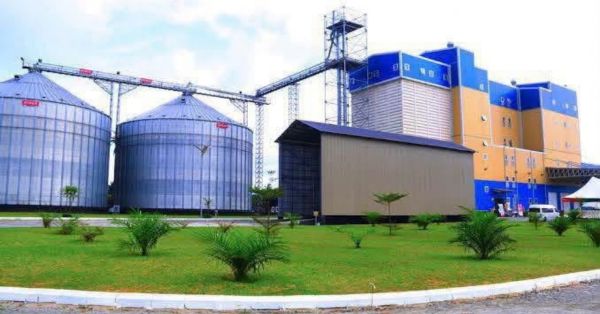
It is important to make this clarification that Kings Flour Mill and Jubilee Syringe Manufacturing Company are not Akwa Ibom State Government-owned factories. They have never been projected to be so. They were private-sector investments attracted to Akwa Ibom State during the Governor Udom Emmanuel administration between 2015-2023.
As a close observer of developments in that era, I can say the role of the state government was principally to create the conditions that would make private investment possible and attractive including land facilitation, security, infrastructure, roads, power access, community engagement and investment-friendly policies. GOVERNMENT DID NOT APPROPRIATE TO DIRECTLY INVEST IN THESE COMPANIES.
The contemporary record provides substantial evidence for this distinction.
On Jubilee Syringe: the evidence is particularly clear
In a 2017 report, THISDAY identified Onur Kumral, a Turkish businessman, as the owner/investor behind Jubilee Syringe.
More importantly, the report quoted Kumral explicitly describing the factory as “100% private investment.”
He explained that the Akwa Ibom Government’s support was in the areas of good governance and economic policies, land and security, while the investment itself remained private.
The same report also described the flour mill being developed in Onna as a privately driven investment owned by Kumral.
Source:
https://www.thisdaylive.com/index.php/2017/06/06/jubilee-syringe-creating-jobs-though-local-production
This is significant because the statement was made while the projects were being developed, not years later as part of a political argument. The company’s management made the same point again.
In another THISDAY interview published in November 2017, Jubilee Syringe Managing Director Zubeyir Gulabi was asked directly whether the company was an investment of the Akwa Ibom State Government, a joint venture, or a 100-percent private investment.
His answer was unequivocal: Jubilee Syringe was a 100-percent private investment and initiative.
But Gulabi simultaneously acknowledged the role of the Emmanuel administration in creating a conducive environment, including suitable land, security and reduced bureaucratic hurdles.
Source:
https://www.thisdaylive.com/2017/11/14/gulabi-our-output-is-still-minimal-relative-to-demand/
Private ownership did not mean absence of government involvement
It meant the government facilitated the environment while the private investor provided the investment.
Governor Udom Emmanuel himself made the distinction
In a June 2017 BusinessDay interview, Governor Emmanuel was asked specifically about the syringe factory and flour mill. His response was direct: the state government was not putting money into either the flour mill or the syringe factory.
He explained that investors were coming because they believed they could operate without problems with host communities and because of the relationships and confidence surrounding the investment environment.
Source:
https://businessday.ng/exclusives/article/commitment-industrial-development-not-political-udom/
That interview is particularly useful because it establishes how the administration itself understood its role at the time.
The government was pursuing investment attraction, rather than claiming equity ownership of every industrial project.
PUNCH reported the same position at the commissioning
At the commissioning of Jubilee Syringe in 2017, PUNCH reported Governor Emmanuel saying explicitly:
“That is not government money but an investment that will create an enabling environment for the benefit of our people.”
Source:
Whatever one’s political assessment of the Emmanuel administration may be, the ownership question is therefore fairly straightforward.
The factory was not being presented at commissioning as a state-owned factory.
The position was confirmed years later
There is even stronger evidence from 2022.
BusinessDay interviewed Akin Oyediran, Managing Director of Jubilee Syringe and then chairman of the Manufacturers Association of Nigeria’s Cross River/Akwa Ibom branch.
Asked specifically about Akwa Ibom State’s equity participation in Jubilee Syringe, Oyediran stated that the company was 100 percent privately owned and that the Akwa Ibom State Government had no equity investment in the company.
At the same time, he credited the government with providing an enabling environment, including roads and other incentives.
Source:
https://businessday.ng/news/article/oyediran-emerges-mans-chairman-cross-river-akwa-ibom-chapter/
That provides a useful distinction between ownership and facilitation. The state could support the investment without owning the company.
Kings Flour Mill follows the same pattern
The evidence surrounding Kings Flour Mill points in the same direction. The German engineering company DMT identifies Kings Flour Mill Ltd. as its client and describes the project as a flour mill located in Onna, Akwa Ibom State.
DMT’s project record gives the construction period as 2017–2019 and states that the facility covers 16,000 square metres and has the capacity to process 500 tonnes of wheat per day.
DMT describes Kings Flour Mill Ltd. as a group company of DMT.
Source:
This provides independent corporate evidence of the project’s private-sector identity.
But the government environment mattered A 2021 BusinessDay report on Akwa Ibom’s industrialisation programme quoted Kings Flour Mill CEO Onur Kumral describing the government’s framework for partnering with private investors.
The report highlighted factors around the Onna industrial corridor, including the road network, proximity to Ibom Power and access to the seaport, as factors that facilitated the flour mill’s operation.
Source:
https://businessday.ng/agriculture/article/kings-flour-mill-here-to-make-the-difference/
Another BusinessDay report from a verification tour of Akwa Ibom quoted Kumral saying investors were able to come to the state because the governor had formulated a framework for partnering with private investors.
Source:
https://businessday.ng/news/article/the-building-of-a-modern-state-the-akwa-ibom-phenomenon/
Again, the language is revealing.
The government created a framework and environment for private investment. That is different from the government owning the investment.
The flour mill was also commissioned as part of an investment-attraction strategy
When Vice President Yemi Osinbajo commissioned the 500-tonnes-per-day flour mill in 2019, BusinessDay reported that he commended the Akwa Ibom Government for its vision in attracting industries to the state and urged other states to provide infrastructure that would assist in attracting investors.
Source:
https://businessday.ng/uncategorized/article/osinbajo-commissions-floor-mill-factory-in-a-ibom/
The description is therefore consistent: Government attracted and facilitated the investment; private investors established and operated the company.
So what exactly did the Udom Emmanuel’s administration do?
1. Investment attraction: actively engaging potential investors.2. Land facilitation: securing/facilitating land for industrial projects.3. Community engagement: helping investors navigate relationships with host communities.4. Security: providing a stable environment for investment.5. Road infrastructure: improving access to industrial locations, like the 29km dualized Etinan-Ndon Eyo road.6. Power environment: proximity/access to power infrastructure was an important factor for industries in the Onna corridor.7. Investment policies: creating policies intended to make Akwa Ibom attractive to private investors.8. Reducing bureaucratic obstacles: creating a more conducive environment for investors.
WHAT REALLY HAPPENED TO THE INDUSTRIES?
Between 2020 and the years that followed, manufacturers faced a combination of shocks that made production increasingly difficult: COVID-19, lockdowns and supply-chain disruptions, foreign-exchange shortages, the steep depreciation of the naira, rising energy costs, inflation, weak consumer demand, high interest rates, port and infrastructure challenges and policy uncertainty.
COVID-19 was a major part of the story. In 2020, Nigeria’s manufacturing sector contracted by 1.51% in Q3, after contracting by 8.78% in Q2. Contemporary industry reporting attributed the deterioration to the pandemic, infrastructure problems and the foreign-exchange crisis, with manufacturers struggling to obtain imported inputs and facing sharply higher alternative-power costs.
The naira averaged about ₦426/$ in 2022 and subsequently weakened dramatically. By September 2024, the NAFEM rate had reached about ₦1,658/$, while the CBN recorded an end-June 2024 rate of ₦1,470.69/$ and a first-half 2024 average of ₦1,360.03/$.
For a factory importing machinery, raw materials, chemicals, spare parts or packaging, this is not simply an exchange-rate statistic.
An imported input that cost ₦426,000 per $1,000 at the former rate could cost more than ₦1.6 million at ₦1,600/$ before considering inflation, freight, energy and other costs.
The Manufacturers Association of Nigeria reported that 767 manufacturing companies shut down in 2023 alone, while another 335 experienced distress. GlaxoSmithKline (GSK) left, Procter & Gamble-the company ultimately moved Nigeria toward an import-only model rather than continuing local manufacturing, Sanofi-Aventis -exited its Nigerian operating structure and moved toward a third-party model, Kimberly-Clark moved its operations away from Nigeria in 2024.
DID SOME OF THE INDUSTRIES IN AKWA IBOM SURVIVE? YES!
The present government may not have industrialization as its major focus but it does not diminish the daring efforts of the former Governor.
Today, Ibom Air lives on as evidence of that industrialization effort. Other states have copied the model. Also, several companies are currently operating in the state in the FREE ZONE ENVIRONMENT engaging in energy, power, petrochemicals, construction, refining, etc. The free trade zone in Akwa Ibom State is the Liberty Oil and Gas Free Zone, which spans over 50,215 hectares across six local government areas: Ikot Abasi, Eastern Obolo, Oruk Anam, Mkpat Enin, Onna, and Ibeno. It will keep expanding. All thanks to the bold efforts of His Excellency, Udom Emmanuel.
Thousands of Akwa Ibom youths are working in those companies.
The Attached video in the comments section is additional support to the above. The full link to the documentary on the Akwa Ibom Star Government YouTUBE page, published 3rd April, 2022
. https://youtube.com/live/Pdj7Lcvq5B4?si=-f2RjZYlfFD8azhC
Finbarr is a former Special Assistant to the Governor, New Media 2015-2023